
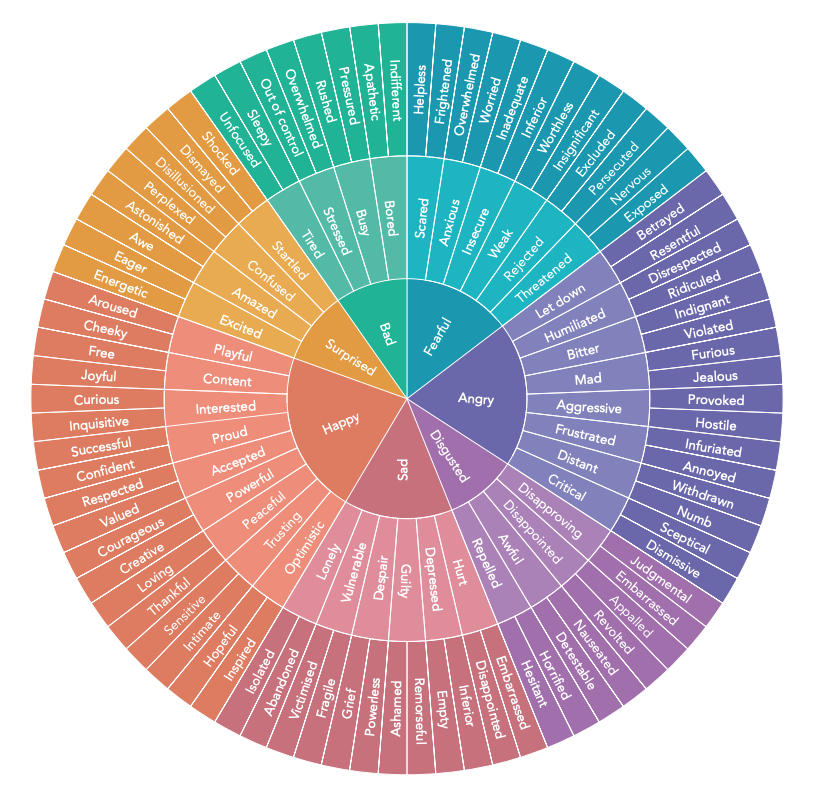
Free feelings wheel

The Feelings Wheel

The Feelings Wheel helps you find the exact word for what you feel. Start with one of six core emotions in the center (happy, sad, angry, fearful, disgusted, or surprised) and move outward to 90 more specific feelings. Tap any feeling to see where you might notice it in your body, a journaling prompt, and a short practice.

Free, no sign-up ·

Keyboard: left and right arrows move around a ring, up and down move out and in, Enter chooses a feeling, and Escape shows the whole wheel.

Start in the center

Pick the core emotion that feels closest, then move outward until a word fits. Each feeling shows where you might notice it in your body, a journaling prompt, and something to try.

A path to emotional freedom and inner peace

Emotions are powerful. They shape the way we see the world, relate to others, and speak to ourselves. Yet most of us were never taught how to truly understand what we feel.

The Feelings Wheel is more than just a colorful chart. It is a map for the heart, guiding us from confusion to clarity, from numbness to awareness, and from pain to peace.

Use it as a daily mindfulness practice to deepen self-awareness, cultivate emotional freedom, and reconnect with your inner truth.

What is the Feelings Wheel?

The Feelings Wheel organizes emotions visually. Core emotions at the center include:

  • Happy
  • Sad
  • Angry
  • Fearful
  • Disgusted
  • Surprised

From there, secondary and tertiary emotions expand outward, helping you move from general to specific emotional awareness.

Gloria Willcox published the original Feeling Wheel in 1982 to help people build a richer vocabulary for their emotions. The wheel on this page is our own version of that idea, with the six basic emotions described by psychologist Paul Ekman at the center, 30 feelings in the middle ring, and 60 more precise words around the edge.

All 96 feelings on the wheel

Each core emotion has five feelings, and each of those has two more precise words. Here is the full list, with where you might notice each emotion in your body and a prompt to explore it.

Happy

Happiness is the sense that things are going well. It ranges from quiet contentment to bright joy, and it draws you toward the people and activities that feel good.

Joyful:
Delighted, Playful
Content:
Peaceful, Grateful
Proud:
Accomplished, Confident
Loved:
Connected, Accepted
Hopeful:
Optimistic, Inspired

You might notice: lightness or warmth in the chest; a relaxed face and shoulders; energy to move, laugh, or connect.

Journal prompt: What made this moment feel good, and how can I make room for more of it?

Start a 2-minute calm timer →

Sad

Sadness is a response to loss, disappointment, or feeling alone. It slows you down so you can take in what happened and reach for comfort and support.

Lonely:
Isolated, Left out
Disappointed:
Let down, Discouraged
Grieving:
Heartbroken, Empty
Guilty:
Ashamed, Regretful
Hopeless:
Powerless, Numb

You might notice: heaviness in the chest or limbs; a lump in the throat or tears; low energy and a slower pace.

Journal prompt: What have I lost or missed, and who could I share this with?

Try a body scan meditation →

Angry

Anger shows up when something feels unfair or a boundary has been crossed. It brings a burst of energy to protect yourself or push for change.

Hurt:
Rejected, Betrayed
Frustrated:
Irritated, Stuck
Resentful:
Bitter, Jealous
Furious:
Enraged, Hostile
Disrespected:
Belittled, Ignored

You might notice: heat in the face or neck; a clenched jaw or fists; a faster heartbeat and breathing.

Journal prompt: What feels unfair or crossed here, and what do I want to happen next?

Breathe with the physiological sigh →

Fearful

Fear is your body's alarm system. It responds to danger, real or imagined, and gets you ready to run, fight, or freeze.

Anxious:
Worried, Overwhelmed
Insecure:
Doubtful, Inadequate
Scared:
Frightened, Panicked
Vulnerable:
Exposed, Fragile
Helpless:
Trapped, Defeated

You might notice: a racing heart; quick, shallow breaths; butterflies or a knot in the stomach.

Journal prompt: What exactly am I afraid might happen, and what would help me feel a little safer?

Try box breathing →

Disgusted

Disgust pushes away whatever feels wrong, from spoiled food to behavior that clashes with your values. It protects your body and your sense of what is right.

Disapproving:
Judgmental, Critical
Repelled:
Revolted, Nauseated
Appalled:
Horrified, Offended
Uncomfortable:
Awkward, Uneasy
Averse:
Hesitant, Avoidant

You might notice: a wrinkled nose or curled lip; a queasy stomach; an urge to turn or step away.

Journal prompt: What feels wrong to me here, and which of my values does it touch?

Write it out in a private journal →

Surprised

Surprise is a quick reaction to something unexpected. It usually lasts only a moment before it turns into another feeling, such as joy or fear.

Amazed:
Awestruck, Astonished
Confused:
Puzzled, Unsure
Startled:
Shocked, Jumpy
Excited:
Eager, Energized
Curious:
Intrigued, Inquisitive

You might notice: raised eyebrows and wide eyes; a quick, sharp breath in; a brief moment of freezing.

Journal prompt: What did I expect instead, and what am I feeling now that the surprise has passed?

Open the breathing timer →

Why most people struggle to name their emotions

  • You were taught to hide emotions (e.g., “Stop crying,” “Be strong”).
  • You were never given the words for emotions, limiting emotional understanding.
  • Emotions can feel overwhelming, especially when multiple arise at once.

The Feelings Wheel gently uncovers the truth beneath the surface, guiding you toward awareness and clarity.

The Feelings Wheel as a meditation tool

It invites you to slow down, breathe, and observe your emotions without judgment. Combined with meditation or breathwork, it becomes a powerful pathway to inner peace.

Why naming emotions heals the heart

Labeling emotions calms the brain, reduces stress, and opens the door to self-compassion. You turn pain into information, and information is power.

In a 2007 brain-imaging study, putting feelings into words lowered activity in the amygdala, the part of the brain that reacts to threats.

How the Feelings Wheel builds emotional intelligence

  1. Self-awareness: Learn what you truly feel in the moment.
  2. Self-regulation: Choose healthy responses to your emotions.
  3. Empathy: Recognize emotions in others.
  4. Communication: Express your truth clearly and respectfully.

Simple daily practice

  1. Pause and take three slow breaths.
  2. Ask yourself, “What am I feeling right now?” Choose a core emotion.
  3. Move outward on the wheel to explore secondary and tertiary emotions.
  4. Speak or write what you feel, e.g., “I feel overwhelmed because…”
  5. Identify what you need to release or receive for emotional balance.

Real-life examples

  • Work stress: Fearful → Insecure → Doubtful.
  • Relationship conflict: Angry → Hurt → Rejected.
  • Joyful moments: Happy → Proud → Accomplished.

Spiritual growth

Embrace every emotion. Fear shows where to create safety, anger shows boundaries, sadness shows what needs release, joy shows where the soul comes alive. Honor emotions to honor your truth.

Journaling with the Feelings Wheel

  • What emotion am I feeling?
  • Where do I feel it in my body?
  • What triggered it?
  • What is it trying to tell me?
  • What do I need to release?
  • What can I learn from this?

Write your answers in our free private journal.

Using the Feelings Wheel with others

Couples, parents, teams, or friends can use it to deepen emotional awareness and improve connection. Emotions are invitations to listen, heal, and grow.

Your journey starts now

Try the Feelings Wheel once a day. Let it guide you inward, help you breathe through discomfort, and celebrate small joys. Over time, you will notice patterns, trust yourself more, and feel lighter.

Frequently asked questions

What is the Feelings Wheel?

The Feelings Wheel is a circular chart of emotion words. Broad core emotions sit in the center and more specific feelings fan out toward the edge, so you can move from a vague feeling, like "bad," to a precise one, like "let down" or "overwhelmed."

How do I use the Feelings Wheel?

Pause and take three slow breaths. Pick the core emotion in the center that feels closest, then move outward until a word fits exactly. Finish the sentence "I feel ___ because ___," and ask yourself what you need next.

What are the six core emotions on the Feelings Wheel?

The six core emotions are happy, sad, angry, fearful, disgusted, and surprised. They follow the basic emotions described by psychologist Paul Ekman, which people in many cultures recognize from facial expressions.

Who created the Feelings Wheel?

Gloria Willcox published the original Feeling Wheel in 1982. Many versions exist today. The wheel on this page is our own, built around Paul Ekman's six basic emotions.

Why does naming a feeling help?

In a 2007 brain-imaging study, putting feelings into words, called affect labeling, lowered activity in the amygdala, the part of the brain that reacts to threats. A precise word also makes it easier to work out what you need and to explain it to someone else.

Can I print the Feelings Wheel?

Yes. Select "Print the wheel" under the wheel to print a one-page copy, or download the image to keep on your phone.

Is the Feelings Wheel good for kids and teens?

Yes. It gives young people words for what they feel, which makes it easier to talk with parents, teachers, and friends. Younger children can start with just the six core emotions in the center.

Sources

  1. Willcox G. The Feeling Wheel: a tool for expanding awareness of emotions and increasing spontaneity and intimacy. Transactional Analysis Journal, 1982
  2. Ekman P. An argument for basic emotions. Cognition and Emotion, 1992
  3. Lieberman MD, et al. Putting feelings into words: affect labeling disrupts amygdala activity in response to affective stimuli. Psychological Science, 2007